
How to Read Key Signatures in Sheet Music: A Beginner's 7-Step Guide
You sit down with a new piece, and between the clef and the time signature there is a small cluster of symbols. Three sharps. Or five flats. It looks like a private code, but it isn't. A key signature is one of the most generous shortcuts in music notation: it saves the composer from writing the same accidental hundreds of times, and it usually tells you, at a glance, which key you are about to play in. Learning to read one takes an afternoon. The payoff lasts as long as you keep playing.
What a Key Signature Actually Tells You
The key signature sits at the start of every staff, immediately after the clef. Those sharps or flats apply to the named notes in every octave — an F sharp in the signature means every F on the page is sharp, high or low — and they stay in force for the whole piece unless something cancels them. Two things can: a new key signature partway through a line, which signals a change of key, or a natural sign placed just before a single note, which cancels the sharp or flat for that note in that bar. Those one-off marks are called accidentals.
What the key signature does not tell you is whether the piece is major or minor. Almost every key signature serves two keys, one of each. It also doesn't promise that the music stays put; plenty of pieces begin in one key and wander into another for a while before returning.
Sharps and Flats Arrive in a Fixed Order
This is the part that makes everything else easy. Accidentals are never placed at random. Sharps always appear in the order F, C, G, D, A, E, B, and flats always appear in exactly the reverse order: B, E, A, D, G, C, F. Look closely at any printed page and you'll see the little symbols climb or descend in that sequence.
The order of sharps
F, C, G, D, A, E, B. A common memory line is Father Charles Goes Down And Ends Battle. Because the order is fixed, a two-sharp signature is always F sharp and C sharp — never anything else.
The order of flats
B, E, A, D, G, C, F, which the same sentence gives you backwards: Battle Ends And Down Goes Charles' Father. A three-flat signature is always B flat, E flat and A flat.
The Circle of Fifths, Without the Mystique
Why that order? Because each new sharp takes you up a fifth. Start with no accidentals in C major. Go up a fifth to G major and you add one sharp, F sharp. Up another fifth to D major and you add C sharp. Keep climbing and the sharps accumulate in exactly the order above. Flats work the same way in the opposite direction: down a fifth from C major is F major, with one flat, B flat; down another fifth brings E flat major and a second flat.
Here is the whole ladder, with the relative minor beside each major key:
- No sharps or flats: C major, or A minor
- 1 sharp: G major, or E minor
- 2 sharps: D major, or B minor
- 3 sharps: A major, or F sharp minor
- 4 sharps: E major, or C sharp minor
- 5 sharps: B major, or G sharp minor
- 6 sharps: F sharp major, or D sharp minor
- 7 sharps: C sharp major, or A sharp minor
- 1 flat: F major, or D minor
- 2 flats: B flat major, or G minor
- 3 flats: E flat major, or C minor
- 4 flats: A flat major, or F minor
- 5 flats: D flat major, or B flat minor
- 6 flats: G flat major, or E flat minor
- 7 flats: C flat major, or A flat minor
You don't need to memorise this table today. It is worth knowing that it exists, and worth noticing that the keys you meet most often in student repertoire — C, G, F, D, B flat, A — sit close together at the top of the ladder.
Two Tricks That Name the Key in Seconds
Once the order of accidentals is familiar, you can skip the table entirely.
For sharp keys: take the last sharp and go up a semitone
One sharp is F sharp; a semitone above F sharp is G, so the key is G major. Four sharps are F, C, G and D sharp; a semitone above D sharp is E, so the key is E major. Six sharps end on E sharp, which is enharmonically F, and the key is F sharp major. This works every time — and it works in any clef, because the signature follows the clef rather than the lines of the staff.
For flat keys: take the second-to-last flat
Four flats are B flat, E flat, A flat and D flat. The second-to-last is A flat, so the key is A flat major. Two flats give you B flat major. Three give you E flat major. For a single flat there is no second-to-last, so simply remember that one flat means F major.
Finding the minor key
The relative minor shares the signature and sits a minor third below the major tonic — three semitones. A major becomes F sharp minor. E flat major becomes C minor. G major becomes E minor. Say it once or twice and it stops needing thought.
Major or Minor? Three Quick Checks
Before you commit, let the music answer the question.
- The last note or chord. Pieces almost always end on the tonic, so look at the final bass note of the piece or the final chord of a section.
- The first chord. Openings tend to establish the key honestly, though introductions do sometimes tease.
- Raised leading tones. In minor keys, composers often sharpen the seventh degree of the scale — a G sharp in A minor, for example. A sharp or natural sign appearing repeatedly on that note is a strong hint you are in minor.
Titles help too. "Sonata in A minor" is not being coy.
Where Key Signatures Bend the Rules
A few practical exceptions are worth filing away. Jazz charts often show no key signature at all and write every accidental as it comes — the page looks busier, but nothing is hidden. Modal pieces may use a signature that matches the notes but not the tonic: a piece written with no sharps and flats might be in D Dorian rather than C major. And in heavily chromatic music, the signature is little more than a housekeeping convention. In all these cases, trust your ears and the final chord more than the symbols at the start.
A Five-Minute Routine Before You Play
Turn reading key signatures into a habit rather than a puzzle.
- Name the clef, then count the accidentals and say the order aloud: "F, C, G."
- Apply the trick — last sharp up a semitone, or second-to-last flat — and say the major key.
- Say the relative minor, three semitones down.
- Scan the first and last bars to decide which of the two the piece is really in.
- Play that major scale, then that harmonic minor scale, before the first bar of the piece.
Do this with every new piece for a month and the process collapses into a two-second glance. That is the whole point: the key signature should disappear into the background, leaving your attention free for the music itself.
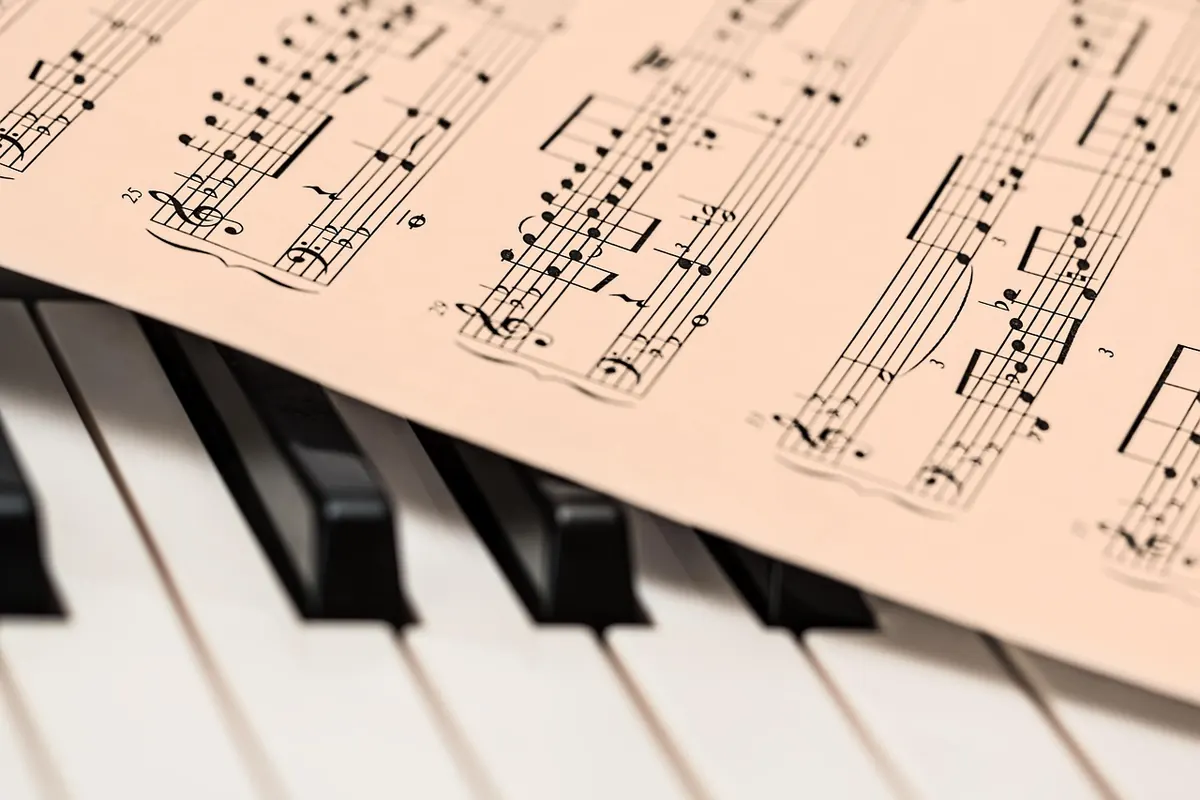
Photo: stevepb / Pixabay