
Common Piano Pedaling Mistakes and Simple Exercises to Correct Them
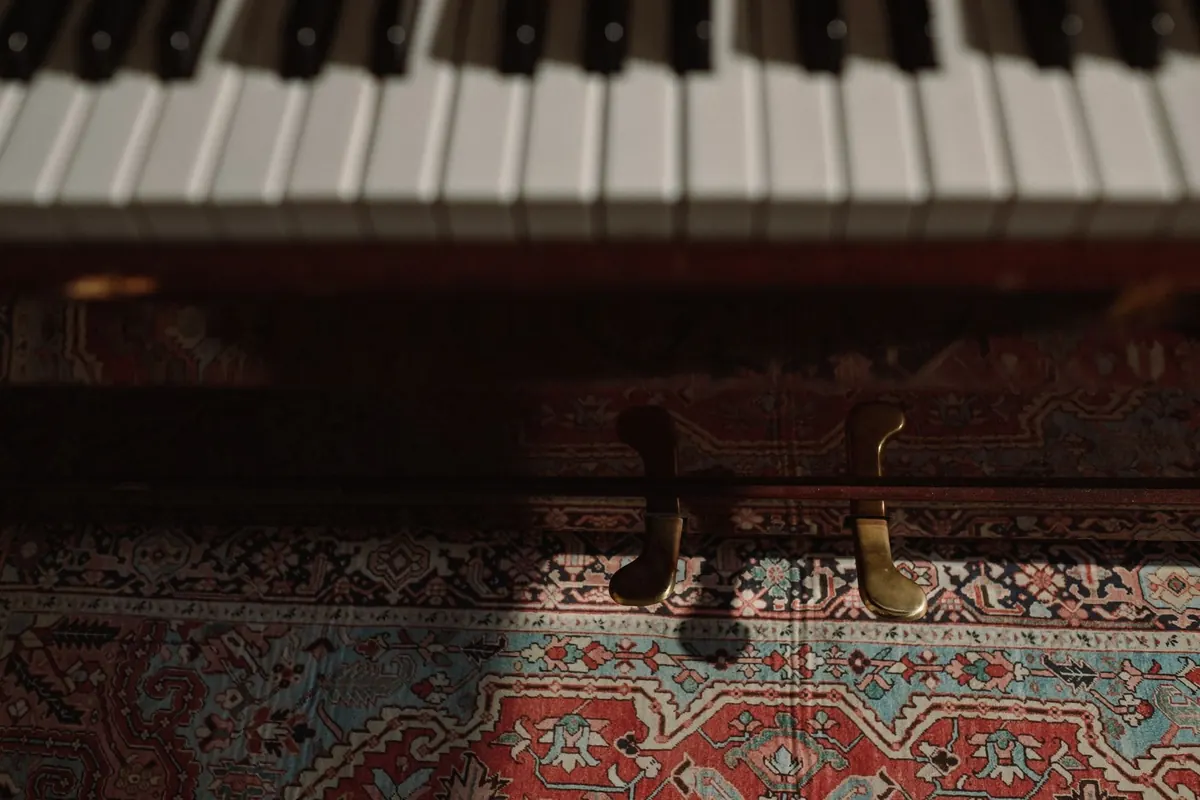
Most pianists spend years on fingerwork and roughly ten minutes thinking about the one mechanism that shapes everything the audience actually hears. The sustain pedal is the easiest part of the piano to operate and the hardest to operate well. It flatters tone, hides small disasters, and — when the timing slips by a fraction of a second — turns a clean chord into a puddle of sound. None of that is a reason to leave it alone. Pedaling is a skill, and it responds to the same slow, specific practice you already give to scales and passagework.
What follows are the mistakes that come up most often in lessons, why they happen, and a handful of short exercises that correct them without adding an hour to your practice day.
What the Pedal Is Actually Doing
Press the sustain pedal and every damper lifts away from the strings. That is the whole mechanism. You are not adding sustain; you are removing the thing that stops sound. Once the dampers are up, every string in the instrument is free to vibrate in sympathy with whatever you play, which is why a single low C on a well-regulated grand can fill a room with overtones you never struck.
Two consequences follow, and between them they explain nearly every pedaling problem. First, the pedal’s real job is to decide which notes belong together. It is a harmonic filter, not a volume knob. Second, the quality of your pedaling is set by when you lift, not by when you press. Most players think about pressing.
The pedal doesn’t make a phrase beautiful. It decides which notes get to keep talking after you’ve played them.
Mistake One: Pedaling After the Note
Watch a pianist play a four-note chord in a slow movement and the foot often moves in the wrong order. The fingers strike, the chord sounds briefly dry, and then the pedal arrives and the sound blooms. On a forgiving instrument it can pass for expression. On a less forgiving one it reads as a small hiccup at the start of every phrase.
The pedal goes down as the keys go down, not after. If you are not sure you can hear the difference, try this: play a single chord, blocking the pedal exactly with the attack. Then play the same chord with the pedal a fraction late. Alternate. The second version sounds like a door opening after the guest has already walked in.
The reverse error is just as common and harder to notice: pressing the pedal just before the new chord arrives, so the previous harmony is caught and carried into the new one. The fix for both is identical. Coordinate the foot with the attack, and change the pedal exactly on the new chord rather than slightly before or slightly after it. A working rule: the pedal changes on the chord, never between chords.
Mistake Two: Harmonic Blur
Slow music is where blur accumulates, because in slow music nothing seems to clash badly enough to notice. Take a passage of repeated chords over a walking bass. You hold one pedal through the bar, the bass moves from tonic to subdominant to dominant, and by the third beat the harmony is a cloud with a melody somewhere inside it.
A thirty-second test: play the passage with the melody only and no pedal. Then add the bass, still dry. Then add the pedal and change it on every bass note. If you cannot hear each change cleanly, you were holding too long — and an audience hears it more clearly than you do, because they are not busy playing.
When in doubt, lift. A slightly dry bar is a small imperfection. A bar of accumulated dissonance sounds like a mistake. Change the pedal whenever the bass changes, or whenever the harmony changes, whichever comes first.
Mistake Three: Chasing a Half-Pedal That Isn’t There
Where the sweet spot actually sits
Half-pedaling gets taught as a technique to be acquired, but on most instruments it is closer to a place to be found. The useful position is just before the dampers touch the strings: enough pressure released to thin the resonance, not so much that the sound dies. Where that point sits depends on the instrument, its regulation, even the humidity in the room. It is not a fixed depth of foot travel you can memorise once.
How to find it on purpose
Play a full chord with the pedal down, then release it very slowly and listen for the moment the sound begins to thin before it stops. Stop your foot exactly there. Repeat until your ankle knows the position. Do this on the piano you will actually perform on — the one at home is not the same animal.
And be sceptical about half-pedaling on an upright. Many vertical actions offer very little travel between full sustain and silence, so players who rehearse delicate half-pedal effects at home are often surprised by a grand in a hall, and the other way round.
Mistake Four: Using the Pedal as Insurance
The pedal is a wonderful place to hide. Uneven fingers, a note that refuses to speak, a jump your hand is not sure of — the instinct is to cover all of it with a wash of resonance. The trouble is that the pedal amplifies what your fingers do badly just as readily as it flatters what they do well.
Some signs you are using it as cover:
- Articulation marks quietly disappear when the pedal goes down, and the passage still sounds acceptable.
- You pedal through rests, so the silence never quite arrives.
- You cannot play the passage at tempo without the pedal.
- You add pedal to bare counterpoint because the lines feel thin without it.
Practice the passage dry until it is even and connected by hand. Then add the pedal. If the pedal is doing structural work — holding the legato together, keeping the tone alive — the fingers need more of it first.
Five Exercises That Rebuild the Habit
Together these take under ten minutes. Use music you already know, not a new piece where the notes are already using up your attention.
- One-chord timing drill. Play a single chord ten times, pedaling exactly with the attack. Then ten times pedaling deliberately late. The aim is to feel the difference in your foot, not only hear it.
- The dry map. Play four bars with no pedal at all, pencil in hand, and mark every place the harmony changes. Those marks are your pedal changes. Decide them away from the sound, where you can think rather than react.
- Bass only. Pedal only when the bass moves, for a page or two. It sounds strange and it teaches your ear to treat the pedal as a harmonic decision rather than a background hum.
- Lift early. Take a passage you blur and practice lifting slightly before the new chord instead of slightly after. Early is far easier to correct than late, and it gives your foot somewhere to aim.
- Record and count. Record the passage on your phone, listen back on headphones, and count how many bars blur. Then fix one bar at a time. Keep only the cleanest take of the week.
A Five-Minute Daily Pedal Routine
Start with sixty seconds of the release-point exercise on a single chord, so your foot recalibrates to the instrument in front of you. Then take one short passage from your current piece — a Chopin prelude with chordal accompaniment, the opening of a Beethoven slow movement, a Satie gymnopédie where the temptation to hold everything is enormous — and play it three times: once with no pedal, once pedaling only on bass changes, once with your planned pedaling. Listen for the third version to match the clarity of the first.
Finish by playing the passage once more and trying to hear only the harmony, as if you were listening from the back of a hall. If the chords arrive clean and the rests stay quiet, your foot is doing its job. If not, lift a little sooner tomorrow. That single adjustment, repeated over a few weeks, does more for most players than any amount of discussion about half-pedal depth.
Photo: cottonbro studio / Pexels